
The Human Premium
What gets rewarded when intelligence becomes abundant

For most of history, intelligence was the constraint.
It was the bottleneck that made hiring strategic, training expensive, and senior leadership rare. Companies that could attract and develop intelligent people had a structural advantage. Companies that could not did not last.
We built credentialing systems around this constraint. We built compensation structures, education industries, immigration policies, and entire economies around the assumption that intelligence would always be in short supply.
That assumption is collapsing.
Not because humans are getting less intelligent, but because cognitive labor is becoming a utility. A model can read your contract, draft your strategy memo, summarize your board deck, screen your applicants, and analyze your customer churn faster than the smartest analyst in your firm. The cost of that labor is dropping toward zero.
When the bottleneck disappears, the value moves.
This is what I have been calling The Human Premium.
It is the dividend paid to whatever cannot be summoned by a prompt.
The premium does not disappear when intelligence becomes free. It concentrates. It concentrates in the capabilities that still require a human to be present, to decide, to interpret, and to take responsibility for what happens next.
After two years of watching how AI is actually being deployed inside HR, operations, and leadership teams, I think there are three of these capabilities. They are the ones that show up in every successful deployment, every senior conversation that does not end in disappointment, and every team that emerges from an AI initiative more capable rather than more anxious.
Relational Intelligence
This is the ability to read what is unsaid.
To hold tension in a room without flinching. To know when to push and when to wait. To move people without moving them around.
A model can summarize what was said in the meeting. It cannot tell you what the silence meant when the CFO did not respond to the head of revenue. It cannot tell you which member of your team is about to resign because they feel passed over, even though their performance review last week said everything was fine.
Relational intelligence is what makes a team safe enough to disagree productively. It is what allows hard feedback to be heard. It is the capability that turns a group of high performers into something that compounds.
It is also the first thing organizations sacrifice when they over-index on speed.
Ethical Reflection
This is the willingness to slow a decision down.
Not because slow is virtuous. Because some decisions deserve to be examined before they are made. Who carries the cost. Who benefits. What gets foreclosed. Whether the longer route is worth taking even when the shorter route is approved.
A model can run the cost-benefit analysis. It cannot tell you whether the cost is one your conscience can hold. It cannot tell you that the answer it gave you, technically optimal, is the kind of decision that erodes trust the moment it lands.
Ethical reflection is not the same as ethics training. It is a habit of pause. It is the leader's willingness to be uncomfortable for a few extra hours rather than push a decision that will haunt the organization for years.
This is the capability that AI is most likely to atrophy if leaders do not protect it deliberately.
Contextual Interpretation
This is the judgment to know which signal matters now.
Models give you everything. They give you the high-confidence answer, the low-confidence answer, the related considerations, the historical analogues, the counter-arguments, and the citations. They are the most thorough research analyst you will ever work with.
What they cannot do is tell you which one of those things matters in this room, with these people, at this stage of the work, in this culture, with these stakes.
That is interpretation. That is the move from information to action. It is what the most senior people in any organization actually do, even though most of them cannot articulate it.
When intelligence becomes free, interpretation becomes the differentiator.
The Three Together
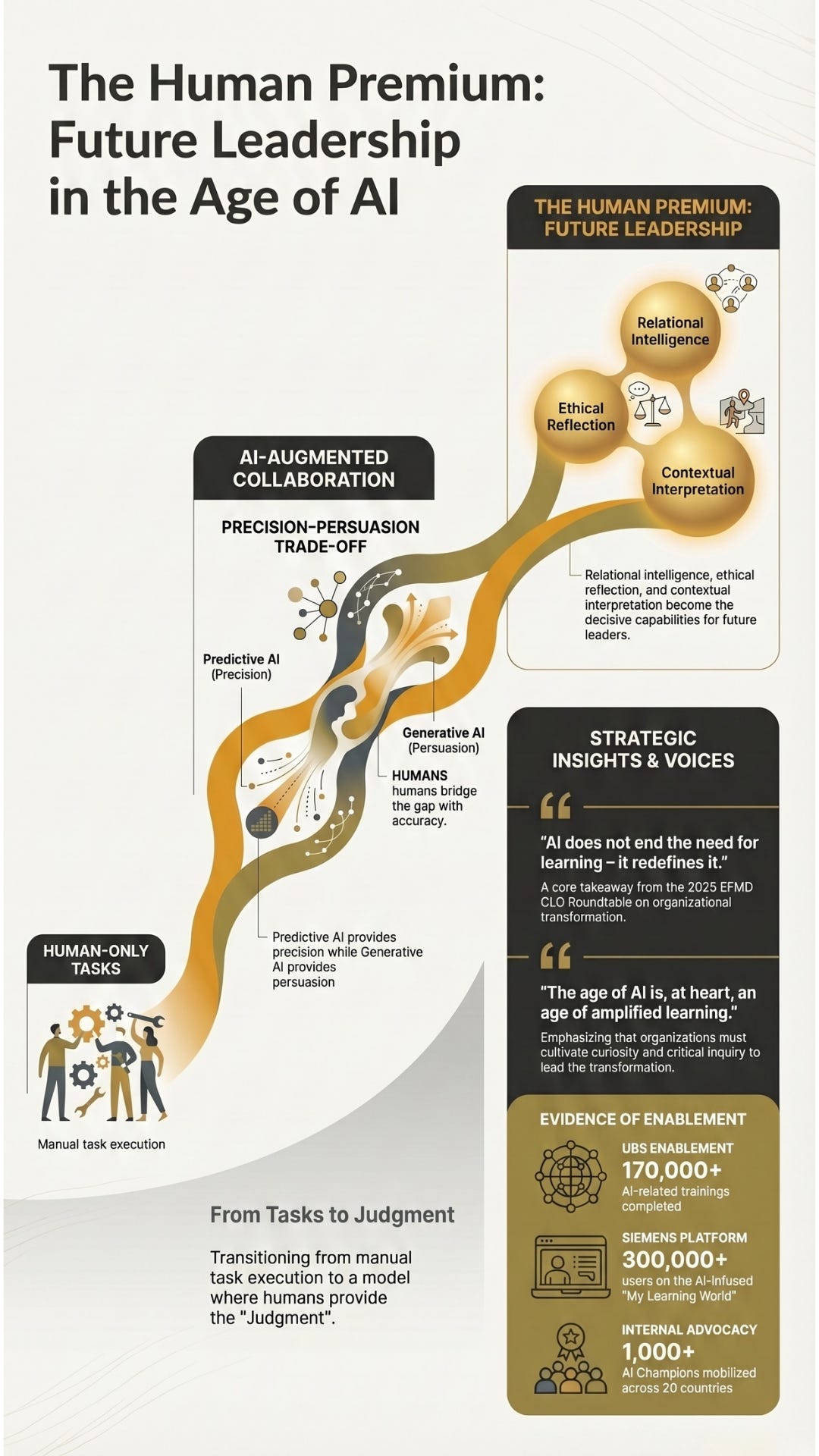
These three capabilities do not work in isolation. The leaders I have watched succeed with AI in the past two years have not been the most technically literate. They have been the ones who could combine all three.
They listen to what is unsaid (relational intelligence), they pause long enough to consider who carries the cost (ethical reflection), and they translate the model's output into the right move for this specific context (contextual interpretation).
They are slower than their peers in some moments. They are decisive in others. They are not afraid of the technology, and they are not seduced by it.
This is what I think the next decade of leadership looks like. The premium is not on speed. It is not on access to the most powerful models. It is on the rare leader who can stand calmly in the room while the algorithms churn, and choose well.
The Human Premium is the economics of remaining human.
It is the part of value that compounds when everything else gets cheaper.
The leaders of the next decade will not be the ones who automate the most.
They will be the ones who know what is worth keeping human.
Most of what comes next will live here.
No newsletter cadence promises. No growth tactics. No five-bullet hacks.
Just the slow work of figuring out what leadership becomes when the math changes.
This essay was written for the person in your network who is exhausted by the AI conversation and looking for a frame that holds.
If that person came to mind, send it.
Love your ability to be so succinct in your writing - it’s wonderfully woven, full of connection, and lingers ….